
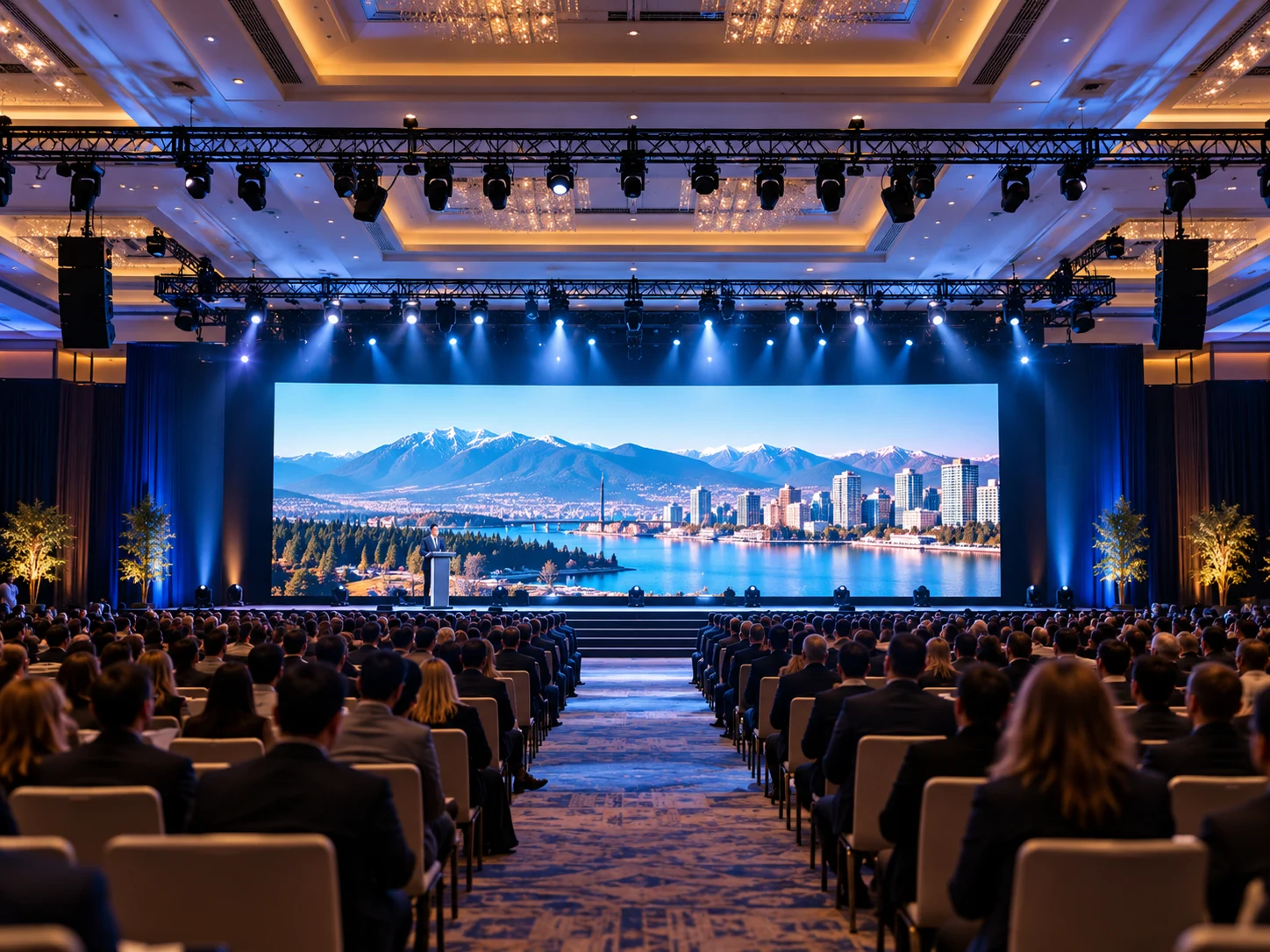
Choosing the right LED wall size for events can transform an ordinary presentation into an engaging visual experience. A screen that’s too small makes content difficult to read, while an oversized display can overwhelm your stage and increase production costs.
Whether you’re organizing a corporate conference, gala, trade show, or outdoor celebration, the ideal LED screen size for events depends on your venue, audience, viewing distance, and presentation content.
This practical LED wall size guide explains how to choose suitable dimensions, calculate screen requirements, and avoid costly planning mistakes.
What Size LED Wall Do You Need for Your Event?
If you’re wondering what size LED wall do I need, start by identifying your event type and how the screen will be used.
The following LED wall dimensions provide practical starting points for common event setups.
| Event Type | Example LED Wall Size | Viewing Setup | Primary Use |
|---|---|---|---|
| Small corporate meeting | 8 × 5 ft | Short room, close seating | Slides and charts |
| Conference or seminar | 10 × 6 to 14 × 8 ft | Medium-depth room | Keynotes and presentations |
| Corporate gala | 12 × 7 to 18 × 10 ft | Wide audience layout | Branding and live video |
| Large conference | 16 × 9 to 20 × 12 ft | Deep room, distant seating | Presentations and live feeds |
| Trade show booth | 6 × 4 to 10 × 6 ft | Close-range viewing | Product demonstrations |
These are illustrative planning ranges, not fixed recommendations. Final dimensions depend on the venue, content, and available LED cabinets.
For LED wall size for corporate events, prioritize clear visuals and comfortable viewing rather than simply selecting the largest available screen.
A wide stage with distant seating may benefit from a larger display, while a smaller venue could achieve better results with a compact, high-resolution LED wall.
How Do Venue and Stage Dimensions Affect LED Wall Size?
Before choosing your LED screen dimensions, measure the actual space available for installation.
Consider these essential measurements:
- Stage width: Leave sufficient room for presenters, podiums, and lighting equipment.
- Ceiling height: Check overhead clearance and mounting limitations.
- Room depth: Identify how far the audience extends from the screen.
- Installation space: Allow room for support structures, cables, and technical access.
- Venue layout: Account for columns, entrances, and potential sightline obstructions.
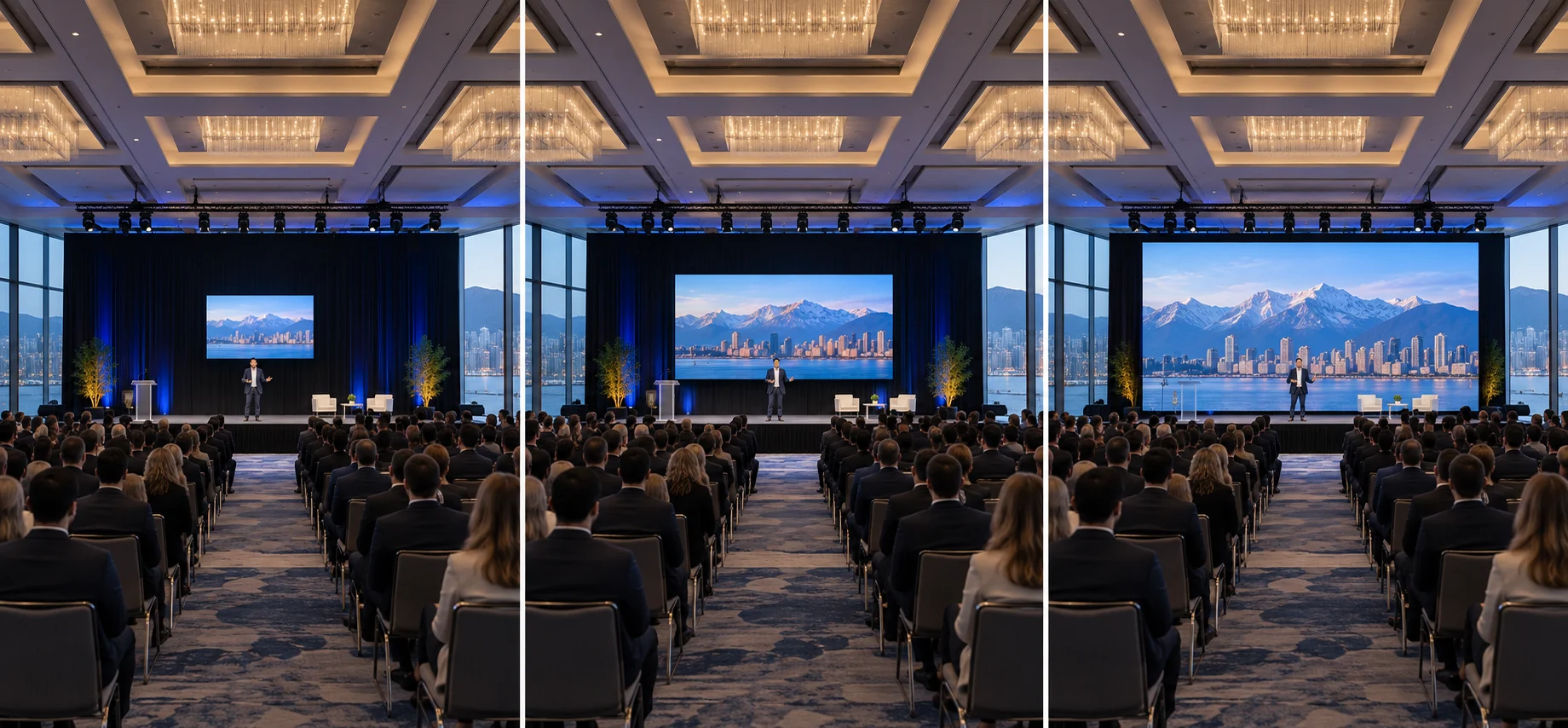
For example, a 24-foot-wide stage doesn’t necessarily need a 24-foot screen. A 14-foot display may provide better visual balance while preserving space for presenters.
Professional stage design Vancouver services help coordinate screen placement with the overall stage arrangement.
Practical tip: Measure the usable stage area, not just the venue’s advertised dimensions. Structural elements and equipment can reduce the available installation space.
How Do Audience Size and Viewing Distance Influence LED Wall Sizing?
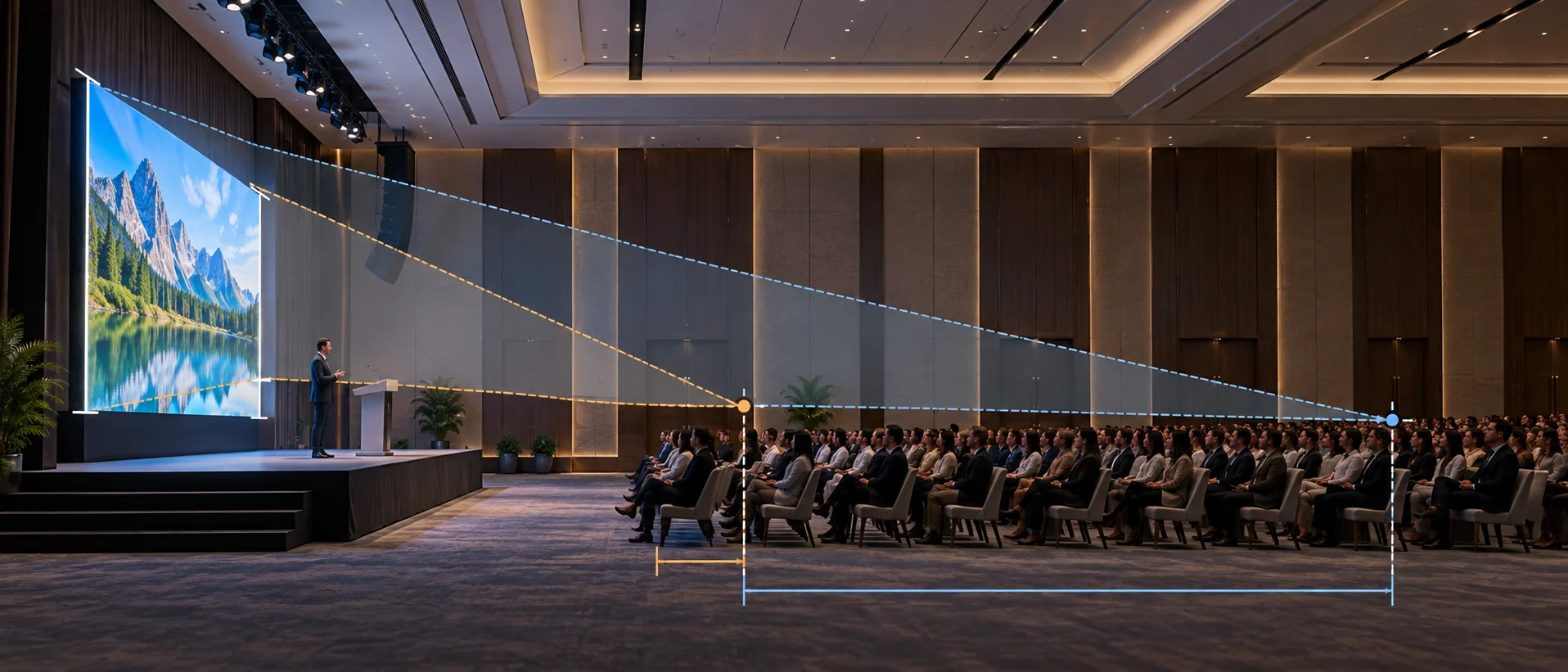
LED wall viewing distance plays a major role in determining whether your audience can comfortably see the content.
As a rough planning estimate, the distance to the farthest viewer can be divided by six to estimate screen height for video-focused presentations.
Estimated Screen Height = Farthest Viewing Distance ÷ 6
For example, if the back row is 60 feet from the screen:
60 ÷ 6 = 10 feet
A display approximately 10 feet tall provides a preliminary starting point.
However, detailed slides and small text may require larger images or more readable content. For text-heavy presentations, a more conservative starting estimate is to divide the farthest distance by four.
These are planning rules of thumb, not guarantees of readability.
Test Your Content From the Back Row
Imagine a financial conference where attendees must read charts, figures, and presentation slides.
A screen may appear impressive from the front row but make smaller numbers unreadable from the back.
Before finalizing your LED wall sizing, test your most detailed slide from the farthest audience position.
If important information isn’t readable, consider increasing the display size, simplifying the content, enlarging the text, or adding side screens.
Remember that audience size alone doesn’t determine the ideal screen. Seating arrangement, audience distance, and sightlines matter just as much.
How Does Pixel Pitch Affect LED Wall Image Quality?
Pixel pitch is the distance between neighbouring LED pixels, measured in millimetres.
Smaller pixel pitch generally means greater pixel density, allowing finer details to appear smoother when viewed up close.
The table below provides a simplified comparison.
| Pixel Pitch | Approximate Minimum Viewing Distance | Common Application |
|---|---|---|
| P1.5 | 1.5 m | Close-range presentations |
| P2.6 | 2.6 m | Corporate conferences |
| P2.9 | 2.9 m | Indoor event displays |
| P3.9 | 3.9 m | Galas and larger venues |
| P4.8 | 4.8 m | Distant audience viewing |
The distances use a rough guideline of one metre per millimetre of pixel pitch. Actual viewing comfort depends on content, display specifications, and individual eyesight.
For example, a P2.6 LED wall generally offers finer detail than a P3.9 LED wall of the same physical size.
However, LED wall resolution also depends on the overall display dimensions and the number of pixels in each cabinet.
Understanding how LED walls work helps explain how individual panels combine to create a seamless display.
Key takeaway: Choose pixel pitch based primarily on the closest viewers and required image detail, while using overall screen size to address visibility from farther away.
How Do Content Type and Aspect Ratio Affect LED Screen Dimensions?
The ideal screen aspect ratio depends on what you plan to display.
A 16:9 aspect ratio is generally suitable for standard presentations and widescreen videos, but not every event requires a traditional rectangular display.
| Content Type | Suggested Configuration |
|---|---|
| PowerPoint presentations | Standard 16:9 widescreen |
| Corporate videos | Match the original video format |
| Stage branding | Wide panoramic display |
| Live camera feeds | 16:9 or multiple screens |
| Product demonstrations | Customized layout |
For corporate keynotes, maintaining the correct content resolution and proportions prevents stretched images or unwanted cropping.
An ultra-wide LED stage backdrop may create a memorable visual effect, but it often requires specially designed graphics.
Similarly, IMAG screens used for live camera feeds should display speakers at natural proportions.
Practical tip: Confirm your presentation and video formats before selecting the final screen configuration. Creating content for the actual display dimensions produces better results than resizing everything at the last minute.
How Do You Calculate LED Wall Width, Height, and Panel Count?
You can make a preliminary LED wall size calculator estimate using three measurements: viewing distance, target aspect ratio, and cabinet dimensions.
Consider a corporate conference with a farthest viewing distance of 18 metres.
Step 1: Estimate screen height
18 ÷ 6 = 3 metres
Step 2: Calculate width for a 16:9 screen
3 × 16 ÷ 9 = 5.33 metres
Step 3: Match the dimensions to available LED panels
Assuming the rental system uses 500 × 500 mm cabinets:
| Measurement | Result |
|---|---|
| Target height | 3 m |
| Target width | 5.33 m |
| Practical cabinet-based width | 5.5 m |
| Horizontal cabinets | 11 |
| Vertical cabinets | 6 |
| Total cabinets | 66 |
| Final physical dimensions | 5.5 × 3 m |
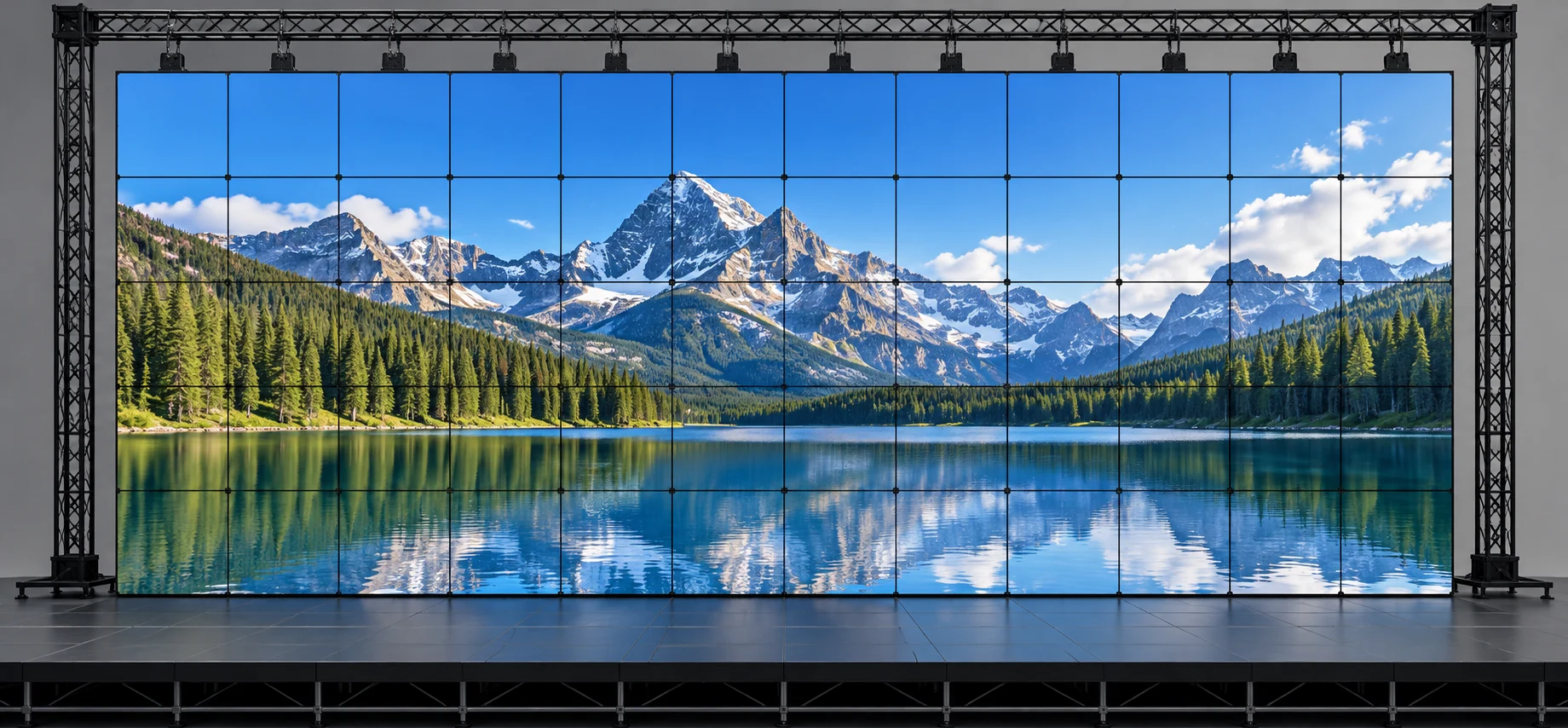
This example illustrates how LED wall panels determine the final buildable size.
The resulting display is close to 16:9, although it isn’t an exact match. Content may require minor layout adjustments.
Does a Bigger Screen Always Mean Better Resolution?
Not necessarily.
A 5.5-metre-wide screen with a nominal 2.9 mm pixel pitch has approximately:
5,500 ÷ 2.9 ≈ 1,897 horizontal pixels
This is a theoretical estimate. The actual native resolution must be calculated using the pixel matrix of the available cabinets.
Therefore, LED display resolution depends on both physical dimensions and cabinet specifications, not screen size alone.
What Changes When Choosing LED Wall Sizes for Outdoor Events?
An outdoor LED screen must accommodate environmental conditions that may not affect an indoor LED wall in the same way.
Three factors deserve particular attention:
- Screen brightness: Outdoor displays often need higher brightness, measured in nits, to remain visible under sunlight.
- Audience coverage: Large outdoor spaces may require bigger screens or additional displays for distant viewing areas.
- Installation safety: Weather resistance, wind loads, mounting structures, and power requirements must be professionally assessed.
Outdoor screen dimensions should never be selected without considering structural capacity and LED wall rigging requirements.
A properly positioned display with suitable brightness and viewing angles can be more effective than a much larger screen installed in the wrong location.
What Should You Confirm Before Renting an LED Wall in Vancouver?
Once you’ve selected an initial LED display size, confirm the practical requirements with your production team.
| Planning Detail | What to Confirm |
|---|---|
| Venue measurements | Available screen width and height |
| Audience layout | Closest and farthest viewing positions |
| Pixel pitch | Suitable detail for your content |
| Display configuration | Panel dimensions and mounting method |
| Content files | Resolution, aspect ratio, and playback format |
| Power and access | Electrical supply and installation requirements |
| Event schedule | Setup, testing, and rehearsal time |
For conferences and corporate productions, incorporating these details into your corporate event AV checklist helps coordinate the screen with sound, lighting, and stage operations.
Danesh Production provides LED wall rental Vancouver services, including scalable display configurations, installation, content management, and on-site technical support.
For example, the company’s LED Wall Solutions portfolio features the Neekoo Gala at Fairmont Pacific Rim and Norooz 2025 at Fairmont Waterfront, illustrating LED display applications in event environments.
Sharing your venue measurements, audience arrangement, presentation requirements, and event schedule allows the technical team to assess a suitable configuration.
Frequently Asked Questions About LED Wall Sizes
Can Multiple Smaller LED Walls Replace One Large Screen?
Yes. Multiple LED walls or dual LED walls can improve visibility in wide venues, particularly when side displays show live camera feeds.
This arrangement can also preserve valuable centre-stage space.
How High Should an LED Wall Be Mounted at an Event?
The bottom of the display should be positioned so attendees can see important content without obstruction from standing guests, furniture, or stage equipment.
The appropriate mounting height depends on seating elevation, sightlines, screen dimensions, and approved structural arrangements.
Does a Larger LED Wall Always Cost More to Rent?
Larger displays often increase LED wall rental cost because they require more cabinets and installation resources.
However, LED wall pricing also depends on pixel pitch, mounting complexity, labour, transportation, and rental duration. A smaller fine-pitch screen may cost more than a larger display with a coarser pitch.
Final Checklist for Choosing the Right LED Wall Size
Before confirming your screen, make sure you can answer these questions:
- Can guests clearly see the content from the back row?
- Is the pixel pitch suitable for the closest viewers?
- Does the display fit the available venue and stage space?
- Does the aspect ratio match your presentation content?
- Are brightness and technical specifications suitable for the environment?
- Have installation, power, and structural requirements been confirmed?
Has the production team reviewed the final screen configuration?
The best LED wall size for events isn’t necessarily the largest or most expensive display. It’s the one that delivers clear visuals, fits your space, supports your content, and makes efficient use of your production budget.
Planning a conference, corporate gala, or live event in Vancouver? Danesh Production can help you evaluate your venue and select an LED wall configuration that creates a professional and engaging audience experience.